 How-to
Is a Tie Clip Necessary for a Polished Look
Last Updated: November 21, 2026
Quick Summary
No, a tie clip is not necessary. It is an optional accessory, and no dress code requires one, but a tie clip holds your tie flat against your shirt and keeps it out of your coffee and soup. Wear one when your tie needs to stay put and the setting rewards polish.
- Fasten the clip horizontally between the third and fourth shirt buttons, never near the knot.
- Grip the tie and the shirt placket together, not the tie alone.
- A tie clip and a tie bar are the same accessory under two names.
- A tie tack pierces the fabric and leaves small holes in expensive silk.
- Match the clip's metal to your watch case, cufflinks, and belt buckle.
Table of Contents
- The Case for and Against Wearing a Tie Clip
- When to Wear a Tie Clip and When to Skip It
- How to Wear a Tie Clip Correctly
- Tie Clip vs Tie Bar: What Is the Difference
- Tie Clip Alternative Options When You Skip the Clip
- A Concise Etiquette and Outfit Checklist
- Choosing a Tie Clip That Matches Your Standard
- Frequently Asked Questions
The Case for and Against Wearing a Tie Clip
Is a tie clip necessary? No. It is an optional accessory, and no dress code requires one. But a tie clip earns its place by holding your tie flat against your shirt, keeping it out of your coffee and your soup.
The question is really about control. A tie that swings, twists, or dips into your lunch is a tie that looks sloppy. A clip fixes that in one small motion.
Pros of a Tie Clip
- Keeps the tie in place. No flapping in wind or drifting over your shoulder.
- Signals attention to detail. A small mark of discipline in professional attire.
- Holds the shirt and tie together. Both layers stay neat through movement.
Cons and Limitations
- It is not required. No workplace rule demands one.
- Wrong placement looks worse than none. Clip too high or too low and people notice.
- Cheap clips slip. Weak tension means the tie drifts anyway.
When to Wear a Tie Clip and When to Skip It
Wear a tie clip when your tie needs to stay put and the setting rewards polish. Skip it when the outfit is casual, the tie is an afterthought, or the clip would draw more attention than the tie itself.
The table below settles most decisions in seconds.
| Situation | Wear It? | Why |
|---|---|---|
| Board meeting or client pitch | Yes | Neat tie, controlled movement, polished image |
| Wedding or black-tie event | Yes | Formalwear rewards careful detail |
| Windy outdoor event | Yes | Stops the tie from lifting and twisting |
| Business casual day, no tie | No | Nothing to clip |
| Slim knit tie, casual shirt | Usually no | A clip can weigh down a soft tie |
| Loud patterned tie | Skip or keep it plain | Two statements compete |
| Dinner with soup on the menu | Yes | Keeps the tie off the table |
How to Wear a Tie Clip Correctly
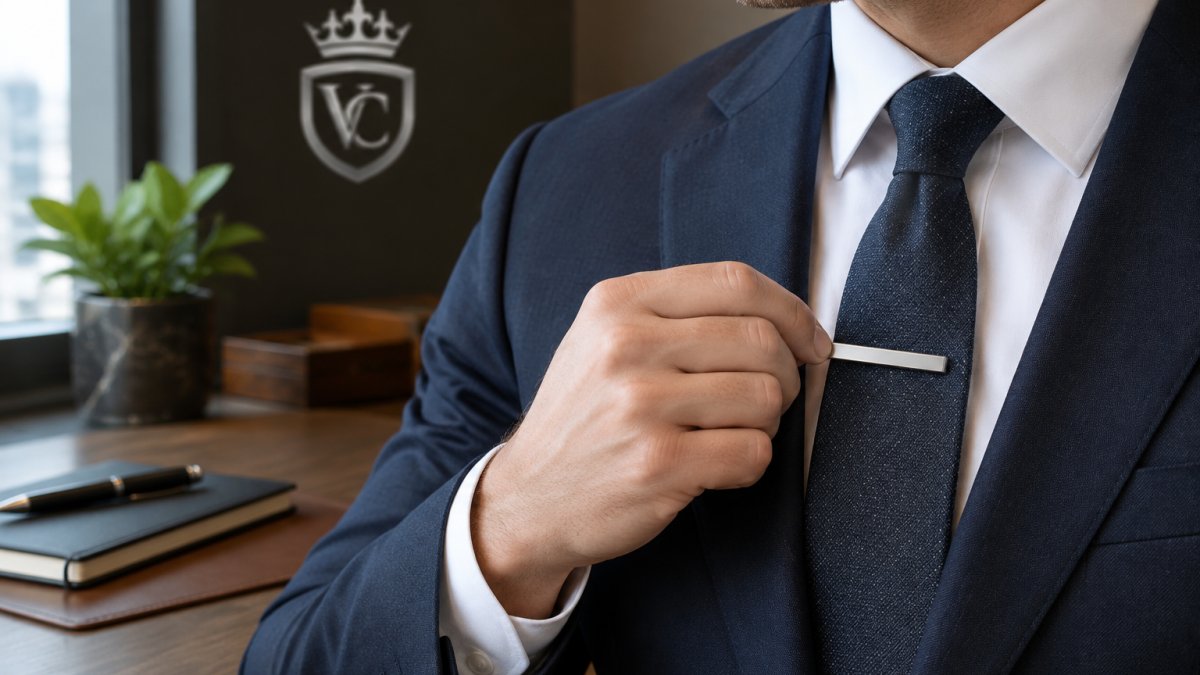
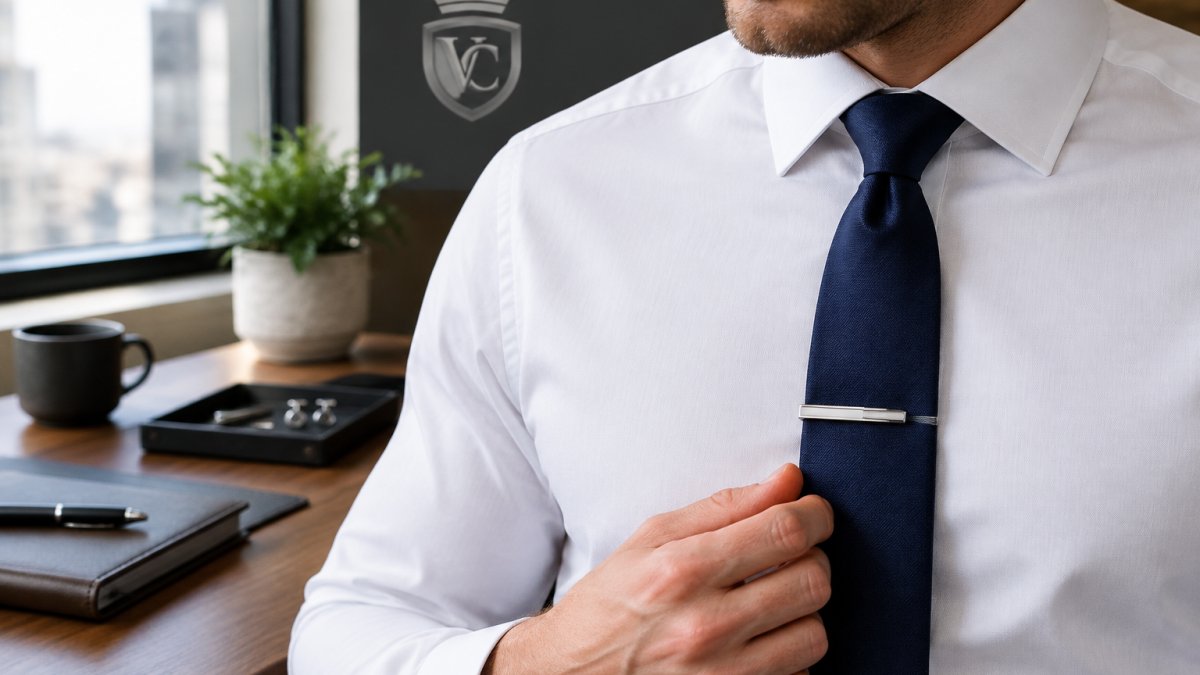
Placement is the whole game. Fasten the clip horizontally between the third and fourth shirt buttons, roughly at the middle of your chest, and grip the tie and the shirt placket together. That single rule fixes most mistakes.
The man is American.
Placement and Fit
- Height: between the third and fourth buttons, never near the knot.
- Angle: horizontal, parallel to the floor.
- Grip: catch the tie and the shirt placket, not the tie alone.
Watch out: clipping only the tie lets it slide free the moment you move, which defeats the entire purpose.
Fabric and Garment Compatibility
Heavy silk and wool ties hold a clip well. Thin, soft, or knit ties tend to sag under the weight of a stiff clip. Match a slim tie with a slim clip, and a wider tie with a slightly longer bar.
Shirt fabric matters too. A fine poplin placket grips cleanly. A thick oxford cloth can push the clip forward, so choose one with firmer tension.
Tie Clip vs Tie Bar: What Is the Difference
A tie clip and a tie bar are the same accessory under two names. Both are horizontal metal fasteners that hold the tie against the shirt. The difference is mostly vocabulary and design: "tie bar" often describes a simpler, flatter piece, while "tie clip" can imply a hinged or spring-loaded mechanism.
A tie pin or tie tack is a different tool entirely. It pierces the fabric with a pin, which many men avoid because it leaves a small hole in expensive silk. For most wardrobes, a clip or bar is the safer choice.
Tie Clip Alternative Options When You Skip the Clip
If a clip is not for you, you still have several ways to keep a tie under control, or to decide the tie does not need controlling at all. The right choice depends on the fabric of your tie, the formality of the setting, and how much you are willing to alter the garment. Here is how the main options compare.
Tie Tack or Tie Pin
A tie tack pushes a pin through the tie and into the shirt, holding the tie at a single point. It is the most secure option for a tie that wants to swing, and it sits lower and less visibly than a clip. Since a tack can mark a favorite tie, keep the rest of the look quietly dependable with the modern man's uniform of a crisp shirt and an everyday watch.
Tie Chain
A tie chain drapes across the tie and hooks to a button or a small bar behind the tie. It holds the tie flat without piercing it and reads as slightly more old-fashioned than a clip. Chains work best on medium-weight ties; on a thin tie the chain can pull the fabric into a curve, and on a heavy tie it may not grip at all.
Vest or Waistcoat
A vest covers the middle of the tie entirely, so the tie cannot flap and no fastener is needed. This is the cleanest solution for formalwear and for anyone who dislikes visible hardware. The cost is warmth and bulk, a vest adds a layer, and it changes the silhouette of the outfit, so it is a style decision, not just a functional one.
A Tie With More Body
Some ties simply hang straighter. A heavier silk, a lined wool tie, or a tie with a firmer interlining will resist twisting and drifting on its own, especially in still indoor settings. This is the lowest-effort option: no accessory, no piercing, no extra layer. It fails in wind and during active movement, which is exactly when a clip earns its keep.
Wearing the Tie With No Fastener
Doing nothing is a legitimate choice. In a calm office, at a seated dinner, or in any setting where you are not moving much, a well-tied tie in a stable fabric will stay reasonably neat without help. The risk is the moment you stand up, reach across a table, or walk into wind, that is when an unsecured tie starts to drift.
How to Choose
| Option | Holds tie? | Damages fabric? | Best for |
|---|---|---|---|
| Tie clip or bar | Yes | No | Everyday business wear, most ties |
| Tie tack or pin | Yes, firmly | Yes, small holes | Inexpensive ties, high-movement days |
| Tie chain | Yes | No | Medium-weight ties, vintage looks |
| Vest | Yes, by covering | No | Formalwear, cold weather |
| Heavier tie, no fastener | Partly | No | Calm indoor settings |
| No fastener at all | No | No | Seated, low-movement occasions |
Watch out: mixing a tack and a clip on the same tie doubles the hardware and looks cluttered, pick one method and commit to it.
Cufflinks are the natural companion piece for a tie-free or clip-free look. If you are weighing that route, our guide to alternatives to traditional tie clips for men covers the options in detail, and our article on whether you can wear cufflinks without a tie answers the styling question directly.
A Concise Etiquette and Outfit Checklist
Most tie clip questions are not about the clip itself but about how it fits with everything else you are wearing. This checklist resolves the coordination decisions that trip people up, in the order you would actually make them.
Metal and Finish
- Match the clip's metal to your watch case, cufflinks, and belt buckle. Silver with silver, gold with gold. Mixed metals can work, but only when the mix is deliberate and repeated elsewhere.
- Keep the finish consistent, a brushed clip beside polished cufflinks looks like an accident, not a choice.
- If you wear no other metal, a plain silver or gunmetal clip is the safest default.
Proportion
- The clip should span roughly the width of the tie's blade, no wider than the tie, no so narrow it looks lost.
- A slim tie takes a slim clip; a wide tie takes a slightly longer bar.
- The clip's thickness should feel proportional to the tie: a chunky clip on a thin tie pulls the fabric out of line.
Pattern and Color
- On a patterned tie, center the clip on a plain area so the two do not compete.
- On a striped tie, place the clip horizontally, never align it with the stripes, which makes the tie look crooked.
- A loud tie is statement enough; keep the clip plain.
Dress Code Fit
- Business formal and black tie: a clip is appropriate and expected to be understated.
- Business casual: wear one only if you are wearing a tie at all.
- Creative or casual settings: a clip can read as try-hard; skip it unless the outfit is deliberately dressed up.
The Final Once-Over
- Clip sits between the third and fourth shirt buttons, horizontal and centered.
- Both the tie and the shirt placket are gripped.
- Tie is pressed and hangs straight.
A clip that matches nothing else in the outfit draws the eye to itself rather than to the tie.
For a broader look at finishing touches, our complete cufflink guide for men pairs well with this checklist. Executives heading to a formal event can also use our black tie checklist for executive cufflink selection to close the last gaps.
Choosing a Tie Clip That Matches Your Standard
A tie clip should look like it belongs to the rest of your outfit. Match the metal to your other hardware, keep the finish consistent, and choose a weight that feels solid without pulling the tie down.
Sterling silver and gold-toned pieces age better than plated mystery metals. If you are ready to invest in polished formal accessories, you can browse VALCREST executive crown sterling silver cufflinks in silver or 18k gold plating, finished with a presentation gift box.
A tie clip is never mandatory, but the details around it are what people remember. If you want accessories that hold their finish and their meaning, VALCREST™ crafts cufflinks in sterling silver and vermeil with timeless design built to last generations.
Frequently Asked Questions
Is it necessary to wear a tie clip?
No, a tie clip is optional. It is a functional accessory that keeps your tie close to the body and prevents it from swinging into food or paperwork, but no dress code requires one. For active professionals who move around during the day, a tie clip adds practical value. For static formal events, it is a bonus accessory that signals attention to detail rather than a necessity.
When should you wear a tie clip?
Wear one when you will be active: presenting, leaning over a desk, eating, or moving between meetings. It also suits business attire and formalwear where a polished, close-to-the-body tie line matters. Skip it at creative or casual workplaces where a tie itself is optional, and avoid pairing it with a waistcoat or cardigan that already holds the tie in place.
What is the difference between a tie clip, tie bar, and tie pin?
A tie clip and tie bar are essentially the same accessory: a horizontal metal fastener that grips the tie and shirt placket. The terms are used interchangeably. A tie pin (or tie tack) is different. It is a small pin with a decorative head that pierces the tie fabric and anchors it to the shirt, which can leave a hole. For fabric longevity, a tie clip is the safer choice.
What should you do if you don't have a tie clip?
Several tie clip alternatives work in a pinch. Tuck the narrow end of the tie into your shirt between two buttons to hold the blade in place. A waistcoat or cardigan buttons over the tie and keeps it close to the body. You can also use a small safety pin from the inside of the tie to the shirt, though it risks fabric damage. None look as clean as a proper clip, but they prevent unwanted movement.
Should I wear a tie clip to a wedding?
A tie clip is appropriate at a wedding if you are wearing a suit and tie, especially in a formal or black-tie-optional setting. Choose a slim, understated metal that matches your cufflinks and watch, and place it between the third and fourth shirt buttons. Skip novelty designs. For a daytime or casual wedding where ties are optional, a clip is unnecessary and can read as overdressed.